How Long Does a Webflow Website Redesign Take? (B2B Timeline 2026)

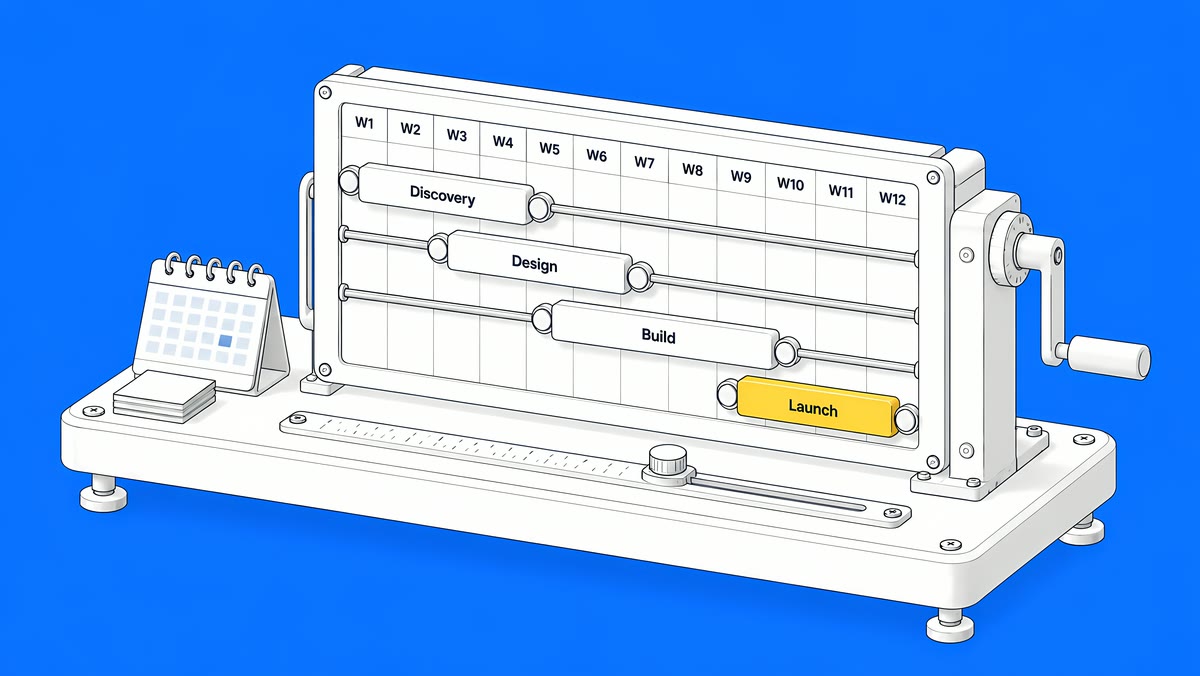
A B2B Webflow website redesign usually takes 8 to 12 weeks from kickoff to launch. A focused refresh of priority pages can ship in about 6 to 8 weeks, while a complex rebuild with a platform migration, rebrand or localisation runs 4 to 6 months. Content readiness and approval speed decide where you land, not page count.
That range is narrower than the "6 weeks to 6 months" you will see quoted for redesigns in general, because Webflow removes a whole stage from the project: there is no separate theme build, plugin setup or hosting configuration. Design, CMS and hosting live in one tool. Below is a week-by-week breakdown, what stretches each phase, and a checklist you can use to keep your own project on schedule.
How long does a B2B website redesign take on average?
Across the agencies that publish benchmarks, a full B2B redesign lands at roughly three to four months. Webstacks puts a standard B2B redesign at 3–4 months (90–120 days), a focused redesign at 6–8 weeks and a complex enterprise redesign at 4–6 months. Brightscout estimates 8 to 16 weeks for a 30–60 page B2B tech site.
On Webflow, mid-size B2B sites tend to sit at the faster end of those ranges. The reason is structural: once a component is designed and approved, the same person can build it in Webflow's visual designer, connect it to a CMS collection and publish it to Webflow hosting. There is no hand-off to a separate theme developer and no plugin stack to configure and test.
What does a Webflow redesign timeline look like week by week?
- Weeks 1–2: Discovery and audit. Analytics and SEO audit, buyer-journey map, URL inventory, success metrics.
- Weeks 2–4: Sitemap, messaging and wireframes. Information architecture, page briefs, low-fidelity layouts.
- Weeks 3–6: Visual design and design system. Homepage and template designs in Figma, component library, responsive states.
- Weeks 5–9: Webflow build and CMS setup. Components, CMS collections, forms, integrations, interactions.
- Weeks 8–10: Content migration, redirects and QA. Migrated content, 301 redirect map, SEO fields, cross-browser and speed testing.
- Weeks 10–12: Launch and optimisation. Domain cutover, analytics checks, team training, 30-day fixes.
The phases overlap on purpose. Development starts on approved templates while later templates are still in design, and content work runs alongside both. Projects that run these as strict hand-offs, one after the other, are the ones that drift to five or six months.
How long does the discovery phase take?
One to two weeks for most B2B teams. This is where you pull Google Search Console and analytics data, list every URL with traffic or backlinks, interview sales about where prospects stall, and agree on the conversion goals the new site will be judged on. Skipping it saves a week and usually costs a month later, when wireframes get reworked for structural reasons nobody settled up front.
How long does design take?
Three to four weeks, starting with the homepage because it sets the type, colour, spacing and button system every other page inherits. After that, inner templates go faster since they reuse approved components. If you are bringing finished Figma files, design time shrinks and the project becomes closer to a Figma to Webflow build.
How long does the Webflow build take?
Three to five weeks for a typical 20–50 page marketing site. What moves the number is the count of unique templates and CMS collections, not the count of URLs. A 200-page site built on six templates can be faster to build than a 40-page site where every page has its own layout.
What makes a website redesign take longer than planned?
Rarely the build. These are the four usual culprits:
- Late content. Brightscout names late-stage content delivery as the most common delay, adding four to six weeks to a project. Assign a content owner before kickoff.
- Too many approvers. When every stakeholder holds a veto, each review round takes twice as long and settled decisions reopen. Name one final decision-maker.
- Scope added mid-build. New page types, integrations or animations requested after design sign-off. Park them for a phase-two release.
- A platform migration nobody scoped. Moving from WordPress, HubSpot or another CMS adds content modelling, redirect mapping and import work. It is manageable when it is in the plan from week one.
The stakes are real. Gartner's research on the B2B buying journey finds buyers spend only 17% of their total purchase time meeting potential suppliers, so for most of the cycle your website is doing the selling on its own. Every extra month on the old site is a month of prospects judging you by it.
Does migrating to Webflow add time to a redesign?
Usually two to four weeks, depending on how much content moves. The extra work is exporting posts and CMS data, mapping old fields to new collections, importing via CSV, and building a 301 redirect map so every old URL resolves to its new home. Webflow lets you import redirects in bulk, and the redirects should be in place before the domain cutover. If you are weighing the move itself, our Webflow vs WordPress comparison for B2B SaaS covers the trade-offs, and our website migration service covers how we run it.
Can you redesign a B2B website in 6 weeks?
Yes, if three things are true: your positioning and messaging are already settled, most copy exists or can be adapted, and one person signs off each milestone. Six-week projects focus on the homepage, navigation, product or solution pages and conversion pages, then roll the rest of the site onto the new system in a second phase. A phased launch gets the pages that drive pipeline live first instead of holding them hostage to the long tail of blog and legacy pages.
Webflow redesign timeline checklist
- Benchmark traffic, rankings and conversions from Search Console and analytics before kickoff
- Export every URL and flag those with traffic or backlinks
- Name one decision-maker and one content owner
- Agree on 2–3 measurable goals (demo requests, contact conversion rate, organic sessions)
- Approve the sitemap before any visual design starts
- Approve the homepage design before inner templates
- Start content writing while design is in progress, not after
- Build approved templates in Webflow while later ones are still in design
- Complete the 301 redirect map and SEO fields before launch week
- Test forms, integrations, analytics and page speed on staging
- Submit the new sitemap in Search Console on launch day and request indexing for key pages
- Book a 30-day review to fix what real visitor data shows
How ActiveSet does it
ActiveSet is a Webflow Premium Partner that plans and builds B2B website redesigns. Our standard Webflow website redesign runs in three stages: Conversion Intelligence (audit and buyer-journey mapping), Strategic Rebuild (architecture, conversion copy and a high-performance Webflow build), and Launch and Optimisation (analytics, team training and a 30-day optimisation period). We confirm the timeline after scoping. Ask about a faster timeline for urgent launches.
Udemy's Production Hub is a good example of why template thinking keeps timelines short. The site holds 100+ learning resources and six asset libraries for instructors, but it is built on a small set of reusable CMS templates, so adding a new resource is a publishing task, not a development task. The same approach runs through our work for Peak XV, Privado, Tessell and AstroPay. As Privado's founder Vaibhav Antil put it, the team "makes sure all the deadlines meet and that also with the highest standards."
Every project includes 30 days of post-launch support, and teams that want ongoing help can move onto Webflow maintenance after that. Wondering about budget as well as time? See how much a Webflow website costs in 2026.
Frequently asked questions
How long does a Webflow website redesign take?
Most B2B Webflow redesigns take 8 to 12 weeks from kickoff to launch. A focused refresh of key pages can ship in 6 to 8 weeks, while a complex project with a CMS migration, rebrand or localisation can take 4 to 6 months.
Is Webflow faster to build on than WordPress?
For marketing sites, usually yes. Design, CMS and hosting live in one platform, so there is no separate theme development, plugin configuration or hosting setup to schedule and test. The time saved is typically in the build and QA phases.
What is the biggest cause of website redesign delays?
Late content. Copy, case studies and approvals arriving after design and development are finished can add four to six weeks. Assigning a content owner and starting copy during design is the most effective way to protect the launch date.
Will a redesign hurt my SEO rankings?
Not if every changed URL has a one-to-one 301 redirect, meta titles and descriptions are carried over, and the new sitemap is submitted at launch. Expect a few weeks of normal fluctuation while Google recrawls the site.
Can I launch a redesign in phases?
Yes. Launch the homepage, navigation, product or solution pages and conversion pages first, then move blogs and legacy pages onto the new system in later releases. This gets your highest-impact pages live weeks earlier.
Ready to plan your redesign?
Tell us your launch date and we will map a realistic Webflow timeline back from it, including where a phased launch could get you live sooner. Book a call with ActiveSet.


